A mood necklace is a type of jewelry that changes color when the temperature of its surface changes. These necklaces are often marketed as a fun way to connect different colors with moods, emotions, or feelings.
People search for mood necklace colours and meanings because they want to know what each color supposedly represents. A necklace may appear blue, green, purple, yellow, black, or another shade, and each color is traditionally given a mood-related interpretation.
The important thing to understand is that a mood necklace does not actually read your emotions. Its color usually changes because of temperature-sensitive material in the jewelry. The mood meanings are a popular interpretation added to make the jewelry interesting and personal.
The exact color chart can also vary between manufacturers. A Claire’s mood necklace, for example, may use a different chart or shade range from another brand.
This guide explains common mood necklace colors, their traditional meanings, differences for women, men, and kids, and how to understand a color chart without treating it as a scientific emotional test.
Background of Mood Necklaces
How mood necklaces became popular
Mood jewelry became popular as a novelty fashion trend because it combined jewelry with the idea of showing emotions through color. The concept was simple: wear a necklace and watch the stone or pendant change color during the day.
The color-changing effect made mood necklaces especially appealing to children, teenagers, and people interested in unusual accessories.
How the color-changing material works
The pendant usually contains a temperature-sensitive material, commonly associated with thermochromic technology. This material reacts to changes in temperature by changing its appearance.
When your skin is warmer or cooler, the material can display a different color.
For example, holding the necklace in your hand for a while may cause its color to change. Moving it into a cooler room can produce another shade.
Does it really detect your mood?
No. A mood necklace cannot directly measure emotions such as happiness, sadness, stress, love, or anger.
Your emotions can sometimes affect body temperature indirectly. For example, stress may cause changes in blood flow or sweating. But the necklace itself is responding primarily to temperature rather than reading your emotional state.
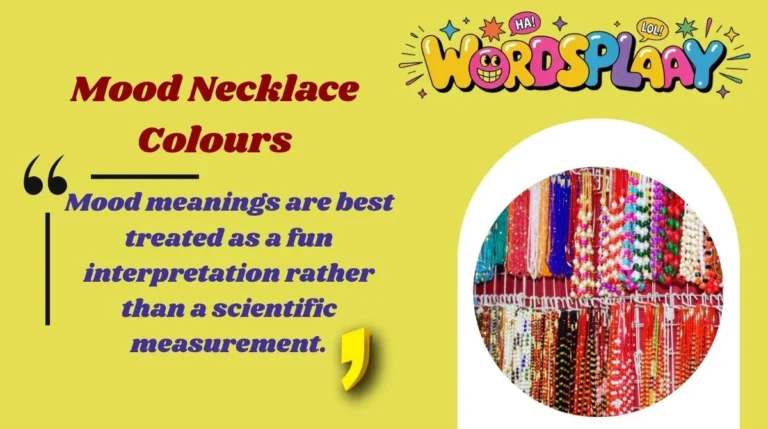
Mood meanings are best treated as a fun interpretation rather than a scientific measurement.
Women Mood Necklace Colours and Meanings
Popular colors associated with women’s mood necklaces
Women often wear mood necklaces as fashion accessories as well as novelty jewelry. The traditional color interpretations are generally the same regardless of gender.
Common interpretations include:
- Blue: calm, relaxed, peaceful, or content
- Green: balanced, comfortable, or normal
- Purple: romantic, passionate, or imaginative
- Pink: affectionate, loving, or emotionally warm
- Yellow: energetic, nervous, or unsettled
- Brown: restless, tense, or worried
- Black: stressed, serious, or emotionally uncomfortable
- Orange: excited, adventurous, or energetic
These meanings are not universal rules. One manufacturer may describe purple as romantic while another may associate it with creativity or excitement.
Why the color may change during the day
A woman may notice that her necklace changes color while she is working, exercising, relaxing, or going outside.
This does not necessarily mean her emotional state has changed. Her skin temperature can change because of:
- Room temperature
- Weather
- Physical activity
- Body heat
- Contact with clothing
- Air conditioning
- Warm drinks
- Direct sunlight
Fashion and personal meaning
Many people enjoy choosing a necklace color based on the traditional mood chart. Others simply enjoy the color-changing effect.
The emotional meaning is symbolic, while the physical color change has a temperature-based explanation.
Kids Mood Necklace Colours and Meanings
Why kids enjoy mood necklaces
Mood necklaces can be entertaining for children because the color-changing effect feels almost magical. Kids may enjoy comparing colors with friends and looking at a chart to see what each shade supposedly means.
They can also be used as a simple introduction to the idea that materials can react to changes in temperature.
Common kids’ mood necklace chart
A typical interpretation may look like this:
| Color | Common Mood Meaning |
|---|---|
| Blue | Calm or relaxed |
| Green | Comfortable or balanced |
| Purple | Happy or romantic |
| Pink | Affectionate |
| Yellow | Nervous or excited |
| Orange | Energetic |
| Brown | Worried or restless |
| Black | Stressed or tense |
The meanings should be presented to children as fun interpretations rather than facts about their feelings.
A useful learning opportunity
Parents can use a mood necklace to explain the difference between observation and interpretation.
For example, if the necklace turns blue, a child might say they are happy. But another explanation could simply be that their skin temperature changed.
This can encourage children to ask questions such as:
Why did the color change?
That makes the jewelry more educational than simply assigning a mood to every shade.
Mood Necklace Color Chart
Common mood necklace colors and meanings
The following chart gives a general guide to traditional interpretations:
| Mood Necklace Color | Common Interpretation |
|---|---|
| Black | Stress, tension, or seriousness |
| Gray | Nervousness or uncertainty |
| Brown | Restlessness or worry |
| Yellow | Nervousness or mixed feelings |
| Orange | Excitement or energy |
| Green | Calm balance or normal mood |
| Blue | Relaxation and peace |
| Dark Blue | Deep calm or happiness |
| Purple | Romance, passion, or creativity |
| Pink | Affection and warmth |
| Red | Strong emotion, excitement, or passion |
Why charts can differ
There is no single official worldwide mood necklace color chart.
Different jewelry makers can use different materials, shades, temperature ranges, and descriptions. Even two necklaces showing a similar shade may have different traditional interpretations.
How to read your necklace
Start by identifying the closest color on the chart provided with your necklace. Then consider the temperature around you.
If the necklace is between two shades, avoid treating one meaning as definite.
A mood necklace color chart is a guide to symbolism, not a diagnostic tool.
Men Mood Necklace Colours and Meanings
Are men’s mood necklace meanings different?
Generally, no. The color-changing material does not respond differently because the wearer is a man.
A blue mood necklace can represent calmness according to the same traditional chart whether it is worn by a man or a woman.
Common interpretations for men
Men’s mood necklaces may be associated with:
- Blue for calmness
- Green for balance
- Purple for passion or creativity
- Red for strong emotions
- Yellow for nervousness
- Orange for excitement
- Black for tension
These are symbolic descriptions rather than scientifically established connections.
Style and color choices
Men’s mood necklaces may have different designs, chains, pendants, or darker settings. The jewelry design can affect how the color appears, but the underlying color-changing principle remains similar.
A person may also choose a necklace simply because they like the design rather than because they believe the mood chart is accurate.
Silver Mood Necklace Colours and Meanings
What does silver mean on a mood necklace?
Silver can refer to the jewelry setting or chain rather than the actual mood-changing color.
Many mood necklaces have silver-colored metal surrounding the temperature-sensitive stone or pendant.
If the stone itself appears silver, gray, or metallic, its meaning depends on the specific manufacturer’s chart.
Silver setting vs silver color
This distinction is important.
A necklace with a silver chain and a blue mood stone does not have a “silver mood.” The silver refers to the jewelry’s finish, while blue is the color being interpreted.
Gray and silver interpretations
When gray is included on a mood chart, it may traditionally be associated with uncertainty, nervousness, or a low-energy state.
But lighting can also make a color appear gray or silver.
Always identify the color of the mood-changing section rather than the metal surrounding it.
Gold Mood Necklace Colours and Meanings
What does gold mean?
Gold can also describe the necklace’s metal finish rather than the mood-changing stone.
A gold-colored necklace may contain a mood-changing pendant that shifts through blue, green, purple, or other colors.
Gold-colored mood jewelry
Gold-tone settings are popular because they give the jewelry a warmer appearance. The metal itself does not determine the emotional interpretation.
If the mood stone turns yellow or golden, use the manufacturer’s color chart to determine its intended meaning.
Why lighting matters
Gold jewelry can make nearby colors look warmer. Bright indoor lights and sunlight can also change how the stone appears.
For that reason, color identification should be done under normal lighting rather than relying on a photograph alone.
Mood Necklace Color Meaning at Claire’s
Why people search for Claire’s mood necklace meanings
Claire’s has been associated with fashion accessories aimed at younger shoppers, including novelty jewelry. People may search specifically for its mood necklace color meanings because they want to understand the chart supplied with a particular product.
However, mood necklace color meanings can vary by product and manufacturer.
How to interpret a Claire’s mood necklace
If your necklace came with a printed color guide, that guide should be treated as the primary reference for that specific product.
The same color can have different descriptions in another mood necklace.
Why online charts may be confusing
An online chart might describe blue as calm while another describes it as happy or relaxed. This does not necessarily mean one necklace is malfunctioning.
The difference can come from:
- Different manufacturers
- Different temperature ranges
- Different color scales
- Different symbolic interpretations
- Different lighting conditions
So if you own a particular Claire’s necklace, compare its actual colors with the chart provided for that product.
Mood Necklace Meaning: What Does Your Color Say?
Blue
Blue is commonly associated with calmness, relaxation, peace, and comfort.
It is one of the most recognizable colors in traditional mood jewelry.
Green
Green is often interpreted as balanced, comfortable, or emotionally neutral.
It may be described as a normal or relaxed state.
Purple
Purple is frequently connected with romance, passion, creativity, or imagination.
Pink
Pink is commonly associated with affection, warmth, caring, or loving feelings.
Yellow
Yellow may traditionally represent nervousness, uncertainty, or an emotionally active state.
Orange
Orange is often connected with excitement, energy, or enthusiasm.
Brown
Brown may be described as worry, restlessness, or tension.
Black
Black is traditionally associated with stress, tension, or a low emotional state.
Remember that these descriptions are symbolic mood interpretations rather than measurements of your actual emotions.
Mood Necklace Meaning in Chat, WhatsApp, Instagram, and TikTok
Does a mood necklace color have a meaning in chat?
Usually, people use the color symbolically rather than scientifically.
For example, someone might post:
My necklace is blue today 💙
They could simply be sharing the color, or they may be using the traditional idea that blue represents calmness.
Instagram and TikTok
On Instagram and TikTok, mood necklaces can appear in fashion posts, videos, product reviews, and nostalgic content.
Creators may use color meanings as part of a story or aesthetic. These interpretations are not necessarily universal.
WhatsApp conversations
Someone might send a picture of a purple mood necklace and say:
Guess what my mood is today?
The intended meaning could depend on the chart they are using.
Social media often treats mood colors as a playful form of self-expression rather than scientific information.
Mood Necklace Meaning in Physics, Medical, and Aircraft Terminology
Physics
Mood necklaces involve a basic physical principle: a material changes its optical appearance as its temperature changes.
This can be discussed using concepts related to temperature-sensitive or thermochromic materials.
However, mood necklace color meanings are not a standard physics system for measuring emotions.
Medical context
A mood necklace is not a medical device and cannot diagnose anxiety, depression, stress, or any other health condition.
Changes in skin temperature can have many causes, so interpreting a necklace color as a medical sign would be unreliable.
Aircraft terminology
Mood necklace color meanings have no standard connection with aircraft terminology.
If you encounter a color code or abbreviation in aviation, it should be interpreted using the relevant aviation documentation rather than a jewelry color chart.
Why this distinction matters
The word “mood” can make the jewelry sound scientific, but its emotional color chart is primarily a novelty interpretation layered onto a temperature-sensitive material.
Common Misconceptions About Mood Necklace Colors
A mood necklace does not read your mind
The necklace cannot detect whether you are happy, sad, angry, or in love.
One color does not prove one emotion
If your necklace turns black, that does not prove you are stressed.
Likewise, blue does not scientifically prove that you are calm.
Everyone’s necklace may not show the same color
Temperature, material, lighting, and product design can affect the appearance.
Mood charts are not universal
Different manufacturers can assign different meanings to the same color.
The necklace is not a medical test
It should never replace professional evaluation of physical or emotional symptoms.
Think of the color chart as entertainment and symbolism rather than a scientific emotional measurement.
Similar Terms and Alternatives to Mood Necklaces
Mood ring
A mood ring works on a similar basic idea. Its color-changing element reacts to temperature and is traditionally linked with different emotions.
Color-changing jewelry
This is a broader term for jewelry that changes appearance based on temperature, light, or another physical condition.
Thermochromic jewelry
Thermochromic jewelry refers to jewelry using materials that change color in response to temperature.
Temperature-sensitive accessories
This category can include novelty products that respond visibly to changes in heat.
The main difference is that a mood necklace is marketed around emotional color meanings, while temperature-sensitive jewelry can simply focus on the color-changing effect.
Differences Between Mood Colors and Actual Emotions
Color symbolism is not emotional science
A mood chart might say that blue means calm. That does not mean every person wearing a blue necklace is calm.
Emotions are complex and influenced by experiences, thoughts, physical conditions, environment, and many other factors.
Temperature is easier to change than mood
Walking outside, touching a cold object, entering an air-conditioned room, or exercising can alter skin temperature.
The necklace may respond to these changes even when your emotional state stays exactly the same.
Why people still enjoy mood jewelry
The appeal comes from combining science-inspired technology with fashion and personal symbolism.
The fun is in seeing the color change and deciding what the color means to you.
Frequently Asked Questions About Mood Necklace Colours and Meanings
What do the colors on a mood necklace mean?
Mood necklace colors are traditionally linked with emotions such as calmness, happiness, romance, excitement, nervousness, and stress. The exact meanings vary by product.
What is the most common mood necklace color?
Blue and green are commonly seen in mood jewelry, although the actual color depends on temperature and the material used in the necklace.
What does blue mean on a mood necklace?
Blue is commonly associated with calmness, relaxation, peace, or happiness.
What does green mean on a mood necklace?
Green is often associated with balance, comfort, or a normal relaxed state.
What does purple mean on a mood necklace?
Purple is commonly linked with romance, passion, creativity, or imagination.
What does black mean on a mood necklace?
Black is traditionally associated with stress, tension, or a serious mood, but the color can also result from temperature conditions.
Do mood necklaces really work?
They can genuinely change color when their temperature-sensitive material changes temperature. However, they do not scientifically measure emotions.
Do men’s and women’s mood necklaces have different meanings?
Usually not. The traditional color interpretations are generally the same regardless of who wears the necklace.
Can children use mood necklaces?
Mood necklaces can be fun novelty accessories for children, provided the particular jewelry is age-appropriate and safely designed.
Why does my mood necklace keep changing colors?
Changes in temperature can cause the color-changing material to shift between shades. Body heat, room temperature, sunlight, and activity can all contribute.
Why is my mood necklace always black?
It could be responding to temperature, product condition, lighting, or the specific material used. A black color does not automatically mean that you are stressed.
Is a mood necklace scientifically accurate?
The temperature response can be based on real physical changes, but the emotional interpretations are not a scientifically reliable way to measure mood.
Are all mood necklace color charts the same?
No. Different products can use different colors and assign different meanings to those colors.
Conclusion:
Mood necklaces are fascinating pieces of novelty jewelry because they combine fashion, temperature-sensitive materials, and traditional color symbolism. Their changing colors can make them fun to wear and interesting to discuss.
The most important point is that mood necklace colours and meanings are symbolic rather than a scientific measurement of emotions. Blue may traditionally represent calmness, green may suggest balance, purple may represent romance, and yellow may be linked with nervousness, but these interpretations can vary between products.
The necklace itself responds mainly to changes in temperature. Your body heat, surroundings, activity, and other environmental factors can affect the color you see.
Whether you are looking at a women’s, men’s, or kids’ necklace, or checking a Claire’s color chart, always use the specific guide supplied with the product when available.
A mood necklace is best enjoyed as a fun accessory that gives you a colorful way to express yourself rather than as a device that can tell exactly how you feel.

Robert Clay is a witty word-lover who turns everyday thoughts into clever puns and smart jokes.
He brings laughter to life with playful humor, sharp timing, and creative wordplay.