
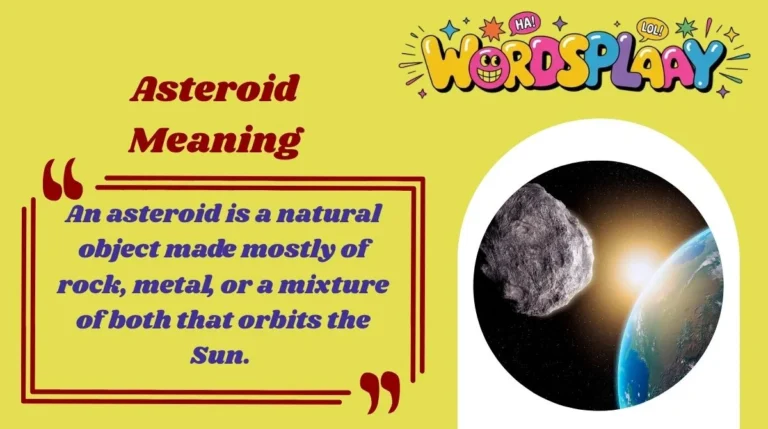
When people search for asteroid meaning, they are usually trying to understand what an asteroid is, where it came from, how it differs from a meteor or comet, and whether one could ever threaten Earth. Asteroids are small rocky or metallic bodies that travel through space, mainly around the Sun.
The word may sound complicated, but the basic idea is simple: an asteroid is a natural rocky or metallic object that orbits the Sun and is much smaller than a planet.
Asteroids are important to scientists because many of them are leftovers from the early formation of our solar system. Studying them can reveal clues about what space was like billions of years ago.
People may also encounter the word in movies, news reports, school lessons, social media, or conversations about space. Understanding the term helps explain related words such as comet, meteoroid, meteor, and meteorite.
This guide explains the asteroid meaning in simple language and answers common questions about these fascinating objects.
What Is an Asteroid?
Simple definition of an asteroid
An asteroid is a natural object made mostly of rock, metal, or a mixture of both that orbits the Sun. Most asteroids are much smaller than planets and do not have enough gravity to become round like large worlds.
They can range from tiny rocky objects to bodies that are hundreds of kilometers across. Their shapes can be irregular because their gravity is not strong enough to pull all their material into a smooth sphere.
Many asteroids travel around the Sun in the region between Mars and Jupiter known as the main asteroid belt. However, asteroids are not limited to this area. Some have orbits that bring them closer to Earth or send them farther into the solar system.
Why are asteroids important?
Asteroids are more than pieces of space rock. They are valuable scientific objects because many have remained relatively unchanged since the early solar system.
An asteroid can act like a natural time capsule from the early history of our cosmic neighborhood.
By studying their composition, movement, size, and surface features, scientists can learn more about how planets formed and how material was distributed around the young Sun.
What are asteroids made of?
Their composition varies. Some contain large amounts of rocky material, while others contain significant quantities of metals. Some also contain carbon-rich material and other compounds.
Their differences make asteroids useful for understanding the variety of material that existed when the solar system was forming.
Background of Asteroids
The early solar system
The solar system formed from a huge cloud of gas and dust. Over time, gravity pulled this material together, eventually creating the Sun and other objects.
Not all of the material became part of planets. Some remained as smaller bodies.
Asteroids are among the remnants of this early material.
Why did they not become planets?
The formation of planets is a long and complicated process. Small particles can collide and stick together, creating increasingly larger bodies. Some eventually become large enough to develop into planets.
In regions where conditions prevented this process from producing a planet, leftover material remained as smaller objects.
Jupiter played an important role in the asteroid belt. Its powerful gravity disturbed material in that region, making it difficult for the objects there to combine into one large planet.
Asteroids through human history
People have observed unusual objects in the night sky for thousands of years, but asteroids were not recognized as a separate class of solar-system objects until modern astronomy developed.
As telescopes improved, astronomers began discovering more of these small bodies.
Today, spacecraft have visited and studied several asteroids directly, giving scientists information that cannot be obtained from Earth-based observations alone.
Where Did Asteroids Come From?
Leftovers from planet formation
Most asteroids are ancient leftovers from the formation of the solar system. They formed from the same general collection of material that eventually produced planets, moons, and other objects.
Some pieces came together while others remained separate.
Collisions created new fragments
Asteroids are not always untouched since their formation. Over billions of years, collisions between objects have broken larger bodies apart.
These impacts can create families of smaller asteroids with related compositions and orbital characteristics.
A large asteroid can therefore produce many smaller fragments after a powerful collision.
Asteroids can change over time
Although asteroids are ancient, they are not completely frozen in history. Impacts, solar heating, radiation, and gravitational interactions can alter their surfaces and paths.
Some can also be pushed into new orbits by gravitational effects from planets.
The asteroid population we see today is the result of billions of years of formation, collisions, and orbital changes.
Asteroid Meaning in Chat, WhatsApp, Instagram, and TikTok
Is asteroid slang?
The word asteroid does not have one widely accepted special meaning in everyday texting. On WhatsApp, Instagram, TikTok, or other social platforms, it normally refers to the actual space object.
However, social media users may use asteroid imagery or references metaphorically.
For example, someone might describe a huge problem as an asteroid heading our way. In that situation, they are comparing the problem to something large and potentially destructive.
Asteroid in memes
Memes may use asteroid images to represent sudden problems, unexpected events, or dramatic situations.
The meaning then comes from the joke rather than from a formal slang definition.
Asteroid in usernames and captions
Someone may also use the word because they like astronomy, science fiction, space photography, or a particular aesthetic.
Therefore, if you see asteroid in a social media profile or caption, do not automatically assume it has hidden slang meaning.
The surrounding post or conversation usually tells you whether asteroid is being used literally or metaphorically.
Asteroid Meaning in Physics, Medical, and Aircraft Terminology
Asteroids in physics
In physics and astronomy, an asteroid is studied as a natural body moving through space under the influence of gravity and other forces.
Scientists can study its:
- Mass
- Size
- Velocity
- Orbit
- Rotation
- Composition
- Gravitational interactions
An asteroid’s movement can be predicted using orbital mechanics and observations.
Asteroids in medicine
Asteroid is not a standard medical term for a space object. If you encounter a similar-looking word in a medical setting, it may refer to a completely different concept or may be a spelling mistake.
For example, the medical word steroid is unrelated to an asteroid.
This distinction is important because adding one letter can completely change the meaning.
Asteroids and aircraft
Aircraft normally do not interact with asteroids because asteroids travel through space while airplanes operate within Earth’s atmosphere.
However, aviation may be involved in observing or responding to information about objects that could approach Earth.
Spacecraft, rather than ordinary aircraft, are generally used for close asteroid exploration.
Common Misconceptions About Asteroids
All asteroids are enormous
This is false. Asteroids exist across a very wide range of sizes. Some are relatively small, while others are hundreds of kilometers across.
Asteroids are always round
Many are irregularly shaped. Smaller objects do not have enough gravity to reshape themselves into spheres.
Every asteroid is dangerous
Most asteroids pose no direct threat to Earth.
They follow different orbits, and many remain far away from our planet.
An asteroid and a meteor are the same thing
They are not.
An asteroid is a body traveling through space. A meteor is the visible streak of light produced when a meteoroid enters an atmosphere and heats up.
Asteroids only exist in the asteroid belt
The main asteroid belt contains many asteroids, but they can also be found in other parts of the solar system.
Some have orbits that cross or approach Earth’s orbital region.
Asteroids are made only of rock
Some contain substantial amounts of metal, while others contain carbon-rich material. Their compositions vary considerably.
Are All Asteroids the Same?
Different compositions
Asteroids can have different chemical and mineral compositions. Some are dominated by rocky material, while others contain more metal or carbon-rich substances.
Different sizes
Their sizes range from relatively small objects to enormous bodies hundreds of kilometers wide.
Different shapes
Many asteroids have unusual shapes because collisions and their low gravity can produce irregular surfaces.
Some resemble potatoes, while others have more complex shapes.
Different orbits
Not every asteroid travels around the Sun in exactly the same path.
Some remain mainly within the asteroid belt, while others have orbits that bring them closer to Earth or other planets.
Different surfaces
Asteroid surfaces can contain craters, rocks, dust, boulders, and other features.
Spacecraft observations have shown that some asteroids are solid bodies, while others may contain loosely packed material held together mainly by gravity.
Asteroids are a diverse group of objects rather than one identical type of space rock.
Similar Terms and Alternatives to Asteroid
Asteroid vs meteoroid
An asteroid is generally a larger natural body orbiting the Sun, while a meteoroid is a much smaller piece of rocky or metallic material moving through space.
The boundary between these categories is not always perfectly simple.
Asteroid vs meteor
A meteor is the streak of light produced when a space particle enters an atmosphere and heats up.
The meteor is the visible phenomenon, not the object itself.
Asteroid vs meteorite
A meteorite is a piece of space material that survives its journey through an atmosphere and reaches the ground.
Asteroid vs comet
Comets are generally rich in ice and dust and can develop visible tails when they approach the Sun.
Asteroids are typically more rocky or metallic and usually do not produce the classic bright tails associated with active comets.
Asteroid vs planet
Planets are much larger and have enough gravity to become approximately round. They also dominate their orbital neighborhoods.
Asteroids are considerably smaller and generally lack these characteristics.
What Can We Learn From Asteroids?
Clues about the early solar system
Because many asteroids formed billions of years ago, they preserve information about the materials available during the solar system’s early development.
Studying them can help scientists understand how planets formed.
Information about Earth’s history
Asteroids have collided with Earth throughout geological history. Large impacts can dramatically affect the environment.
Studying impact evidence helps researchers understand major events in Earth’s past.
Understanding planetary materials
Different asteroids contain different combinations of minerals and other substances.
Examining them helps scientists understand how material was distributed throughout the early solar system.
Testing space technology
Asteroids also provide opportunities to test spacecraft navigation, landing techniques, sample collection, and other technologies.
Future missions may help scientists understand these objects in even greater detail.
Planetary defense
Observing asteroids helps researchers identify objects whose orbits could potentially bring them close to Earth.
Tracking asteroids is important because knowing where an object is today helps scientists predict where it may be in the future.
Asteroid vs Similar Space Words
Understanding related space vocabulary makes the asteroid meaning much easier to remember.
| Word | Simple meaning |
|---|---|
| Asteroid | Rocky or metallic body orbiting the Sun |
| Meteoroid | Smaller piece of space rock or metal |
| Meteor | Streak of light caused by material entering an atmosphere |
| Meteorite | Space material that reaches the ground |
| Comet | Object containing significant ice and dust that can become active near the Sun |
| Planet | Large body that orbits a star and has become approximately round |
The easiest way to remember the difference is to focus on where the object is and what happens to it.
A rocky body traveling through space may be an asteroid. If a smaller piece enters Earth’s atmosphere and creates a streak of light, we call the visible event a meteor. If part of it reaches the ground, it can become a meteorite.
Will an Asteroid Ever Hit Earth?
Can asteroids collide with Earth?
Yes. Earth has been struck by asteroids and other space objects throughout its history.
Most incoming space material is small and burns up in the atmosphere or causes little effect. Very large impacts are much less common.
Are scientists watching them?
Astronomers track many objects that pass near Earth’s orbit. Observations help scientists calculate their trajectories and estimate whether an object could come close to Earth.
A close approach does not automatically mean an impact will happen.
What happens during an asteroid impact?
The effects depend heavily on the object’s size, speed, composition, and impact location.
A very small object may produce little or no damage. A much larger impact can create a crater, release enormous energy, and affect the surrounding environment.
Should people worry about an asteroid?
There is no reason to assume that every asteroid passing near Earth is dangerous.
Scientists continuously improve detection and tracking methods because early knowledge provides more opportunity to study and prepare for potentially hazardous objects.
Frequently Asked Questions
What is the simple meaning of asteroid?
An asteroid is a natural rocky or metallic object that travels around the Sun and is much smaller than a planet.
What does asteroid mean in simple words?
In simple terms, an asteroid is a space rock or metal-rich body orbiting the Sun.
Where are most asteroids found?
Many known asteroids are located in the main asteroid belt between Mars and Jupiter, although asteroids can exist in other regions too.
Are asteroids bigger than planets?
No. Asteroids are generally much smaller than planets.
Are asteroids dangerous?
Most are not dangerous to Earth. Only a small portion have paths that could potentially bring them close enough to pose a concern.
Can an asteroid destroy Earth?
A sufficiently large impact could cause catastrophic effects, but extremely large impacts are rare. Scientists monitor potentially hazardous objects to better understand their trajectories.
Is an asteroid the same as a meteor?
No. An asteroid is a space object. A meteor is the streak of light produced when material enters an atmosphere.
Is an asteroid the same as a comet?
No. Asteroids are generally rocky or metallic, while comets contain substantial ice and dust and can become active near the Sun.
Can an asteroid have a moon?
Yes. Some asteroids have smaller objects orbiting them.
Why do scientists study asteroids?
They can provide clues about the formation of the solar system, planetary materials, collisions, and the history of Earth.
Can humans land on an asteroid?
Spacecraft have already visited and operated around asteroids, and asteroid missions have demonstrated that close exploration is possible.
What is the difference between asteroid and meteorite?
An asteroid is a space body orbiting the Sun. A meteorite is space material that survives passage through an atmosphere and reaches the ground.
Conclusion:
The asteroid meaning is simple: an asteroid is a natural rocky, metallic, or mixed-material body that travels around the Sun. Although many people imagine asteroids as giant space rocks racing toward Earth, most are simply ancient objects following their own paths through the solar system.
Many asteroids formed from material left over during the birth of the solar system. Their composition, shape, size, and orbit can vary greatly, making them valuable subjects for scientific research.
Understanding the difference between an asteroid, meteoroid, meteor, meteorite, comet, and planet also makes space terminology easier to understand.
Asteroids are important because they preserve clues about our cosmic past while helping scientists study planetary formation and potential space hazards.
For everyday conversations, the word asteroid normally refers to the space object itself. Any metaphorical meaning on social media depends on the context in which the word is used.

Robert Clay is a witty word-lover who turns everyday thoughts into clever puns and smart jokes.
He brings laughter to life with playful humor, sharp timing, and creative wordplay.